
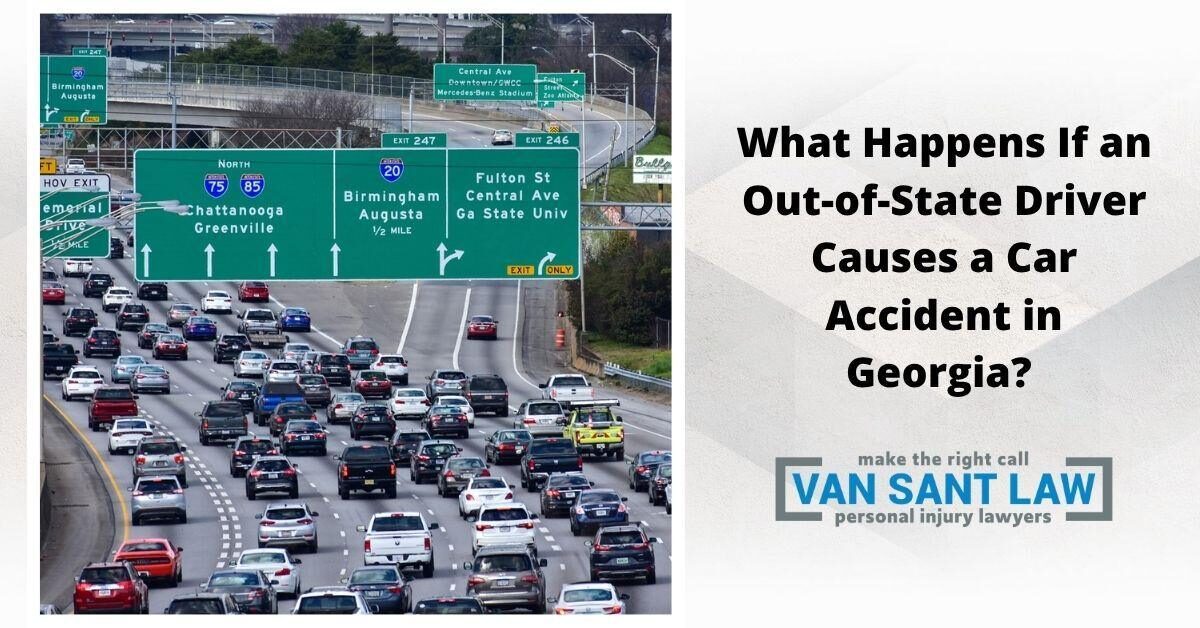
Georgia’s highways see drivers from across the country every day. Whether someone is traveling through Atlanta on I-75, heading south on I-85, visiting family, or vacationing in Georgia, an out-of-state driver can cause a crash just like a local motorist.
But when the person who hit you has a driver’s license, vehicle registration, and insurance policy from another state, you may wonder what that means for your claim.
An accident with an out-of-state driver in Georgia can create additional insurance and legal questions, but the fact that the other driver lives elsewhere does not prevent you from pursuing compensation.
Which State’s Laws Apply After a Georgia Car Accident?
When a car accident occurs in Georgia, Georgia law generally plays an important role in determining liability and the injured person’s right to pursue compensation.
That means an out-of-state driver does not get to avoid responsibility simply because they live in Florida, Tennessee, Alabama, South Carolina, or another state.
Georgia is an at-fault state for car accidents. When another driver’s negligence causes a collision, the injured person may pursue compensation from the responsible driver and their insurance company for losses such as medical expenses, lost income, property damage, and pain and suffering.
However, accidents involving people from different states can raise additional questions about insurance policies, jurisdiction, and where a lawsuit can be filed.
What If the Other Driver Has Insurance From Another State?
Seeing an unfamiliar insurance company or an out-of-state policy after a crash can make the claims process seem more complicated.
The driver’s insurance policy does not stop applying simply because the collision occurred outside the state where the policy was purchased. However, coverage limits and policy provisions can vary, making it important to determine exactly what coverage is available.
Georgia requires resident drivers to maintain minimum liability coverage of $25,000 for bodily injury to one person, $50,000 for bodily injury per incident, and $25,000 for property damage. An out-of-state driver’s policy may have different stated limits based on their home state’s requirements.
The insurance company should investigate the Georgia accident and determine what coverage applies. When serious injuries are involved, however, determining the available policy limits can become particularly important.
What If the Out-of-State Driver Does Not Have Enough Insurance?
An out-of-state driver’s liability coverage may not be enough to compensate you fully after a serious accident.
Hospitalization, surgery, rehabilitation, time away from work, and long-term medical treatment can quickly result in losses that exceed an at-fault driver’s available insurance.
Your own uninsured or underinsured motorist coverage may provide an additional source of compensation depending on your policy and the circumstances of the crash. This coverage can become especially important when the driver who caused the accident has no insurance or insufficient liability coverage.
An investigation may also reveal additional insurance policies or responsible parties that should be considered before a claim is resolved.
Does an Out-of-State Driver Make It Harder to Prove Fault?
Where the other driver lives does not change the importance of evidence.
A police report, photographs and videos, witness statements, vehicle damage, traffic-camera footage, medical records, and other evidence may all help establish what happened. Getting accurate information at the scene can be particularly important when the other motorist will soon return to another state.
Make sure the driver’s license information, license plate state, insurance carrier, policy information, and contact information are documented when possible.
You should also report the accident to your own insurance company promptly. Even if another driver appears clearly responsible, your own coverage could eventually become relevant.
Can You File a Lawsuit Against a Driver Who Lives in Another State?
The fact that the at-fault driver went home after the accident does not necessarily prevent an injured person from pursuing a claim or lawsuit.
However, cases involving an out-of-state defendant can raise procedural questions not present in every car accident case. Where a lawsuit can be filed, how the defendant is formally served with legal documents, and which insurance policies apply may need to be addressed.
These issues can become even more significant when fault is disputed or the insurance company refuses to offer compensation that reflects the full extent of the injuries.
If an out-of-state driver caused your Georgia car accident, you do not have to figure out multiple insurance policies and state-specific issues on your own. Van Sant Law can investigate the crash, determine what insurance coverage may be available, and help you understand your options for pursuing compensation.